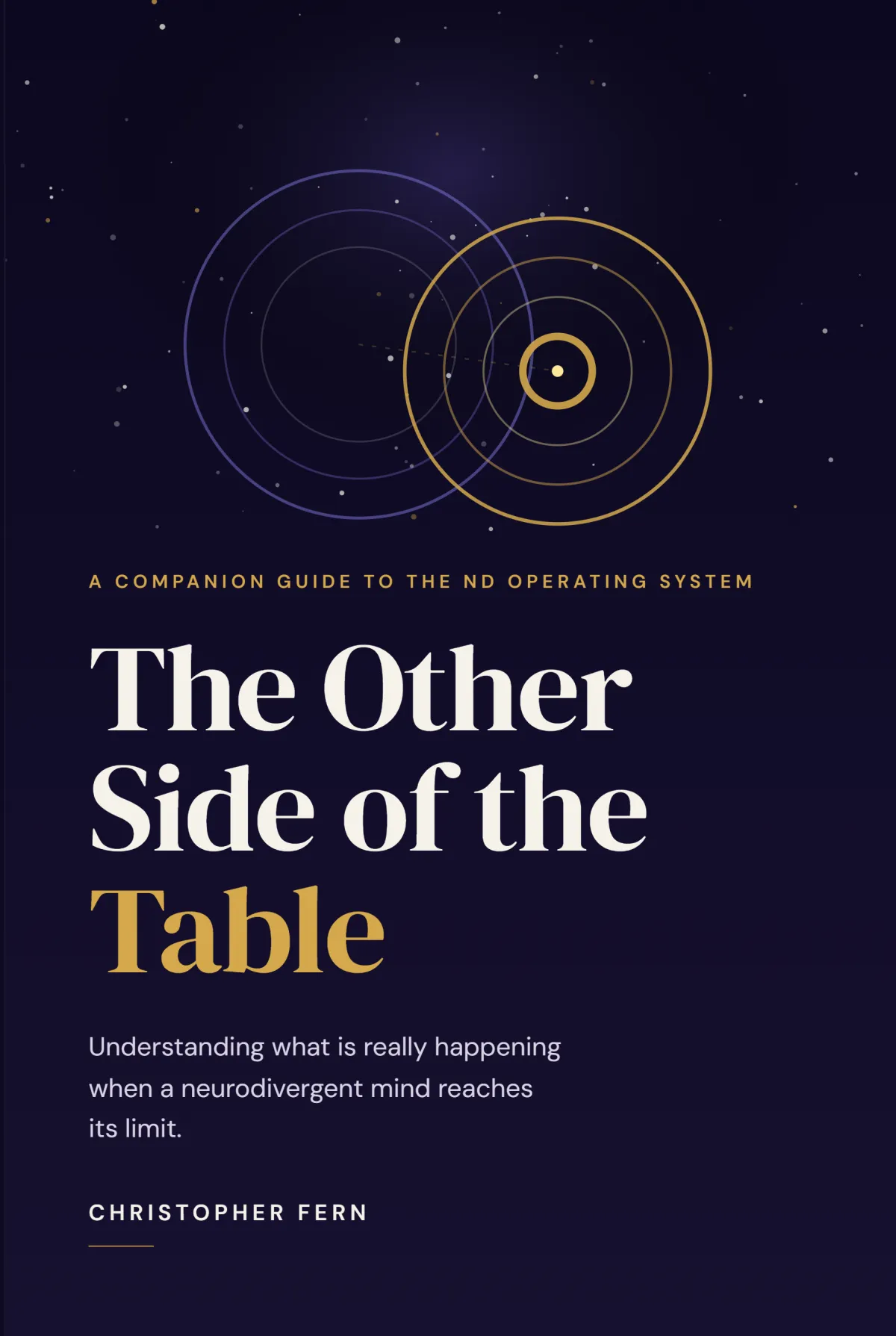
A COMPANION GUIDE TO THE ND OPERATING SYSTEM
Finally understand what's happening
when someone you love
goes quiet.
When a neurodivergent person shuts down, withdraws, or seems unreachable - it isn't attitude, effort, or will. The Other Side of the Table gives you the framework to finally see what's actually happening inside their mind.

1 in 5 people are neurodivergent. Every workplace, classroom, and family is affected. Most people are using the wrong map.
WHAT THIS BOOK IS
A different instrument
for seeing
This book exists because of a gap — not a flaw in any person, but a structural gap between how a neurodivergent brain actually works, and what neurotypical people assume must be happening inside it.
That gap causes suffering. Not because anyone intends harm, but because the map most people are using to navigate another person's mind is simply the wrong map.
This guide will not tell you that ND people are fragile, or that NT people are the problem, or give you a list of things to fix. What it will do is give you a completely different instrument for seeing.
"They are not looking at a miscalibrated telescope. They're looking at a completely different instrument."
— CHRISTOPHER FERN, CHAPTER ONE
THE CENTRAL FRAMEWORK
The Table — the model that explains everything else
The Table is a model for the working memory of the neurodivergent mind. Everything currently being tracked — every open task, every pending conversation, every sensory input — sits on the Table. The Table is not infinite. It has edges. Things can fall off.
01
The Table Starts Smaller
The ND Table begins with less default space. Before any challenge is introduced, the neurodivergent person is already working with less available surface than their NT counterpart. This is not about intelligence — it is about working memory capacity.
02
The Table Shrinks As It Fills
As items accumulate, the Table itself appears to shrink. The felt sense of available capacity decreases faster than the actual decrease. This is why an ND person can seem overwhelmed by something that looks manageable from the outside.
03
Things Fall Off
When the Table gets too full, items don't just become hard to access — they fall off entirely. This is not selective forgetting or passive-aggressiveness. It is what happens when working memory reaches its limit. The ND person knows it's happening. That awareness is itself deeply distressing.
WHO THIS IS FOR
Written for the people on the other side
This guide is primarily for neurotypical people navigating relationships with neurodivergent individuals. But neurodivergent readers will find it here too — as something to hand to the people in their lives who are trying to understand.
Partners & Spouses
When your partner shuts down or withdraws, and you don't know if you did something wrong or what's really happening.
Parents
When your child collapses after school, melts down over something small, or goes completely unreachable.
Managers & Colleagues
When a brilliant team member suddenly stops responding, misses deadlines, or seems checked out despite clear ability.
Friends
When someone you care about goes dark, cancels plans last minute, or can't explain why they disappeared.
INSIDE THE BOOK
What you'll come away with
Ch. 1Two Different Instruments
Why the problem is not attitude, effort, or will — and the Galileo analogy that reframes everything.
Ch. 2The Table
The central model for understanding neurodivergent working memory and why it behaves the way it does.
Ch. 3The Three ND Differences
The Table starts smaller, shrinks as it fills, and things fall off — each explained in practical terms.
Ch. 4What Table Management Looks Like
Learning to read the external signals of an ND mind in emergency mode — from silence to avoidance to shutdown.
Ch. 5How to Respond — Not React
Practical frameworks for navigating the moments that matter most, without making the table worse.
ABOUT THE AUTHOR
Christopher Fern
Christopher Fern is the founder of Energy Economics and creator of the ND Operating System — a framework for understanding how neurodivergent minds work, designed for the people living alongside them.
The Other Side of the Table is the companion guide to that video series, translating the neuroscience into frameworks you can carry with you into the relationships that matter most.
GET THE BOOK
Start seeing with a different instrument.
The map you've been using was built for a different kind of
mind. This guide gives you a better one.
© 2026 Christopher Fern. All rights reserved.
Links: Privacy Policy | Terms
Contact: (optional contact email or small print can be added here)